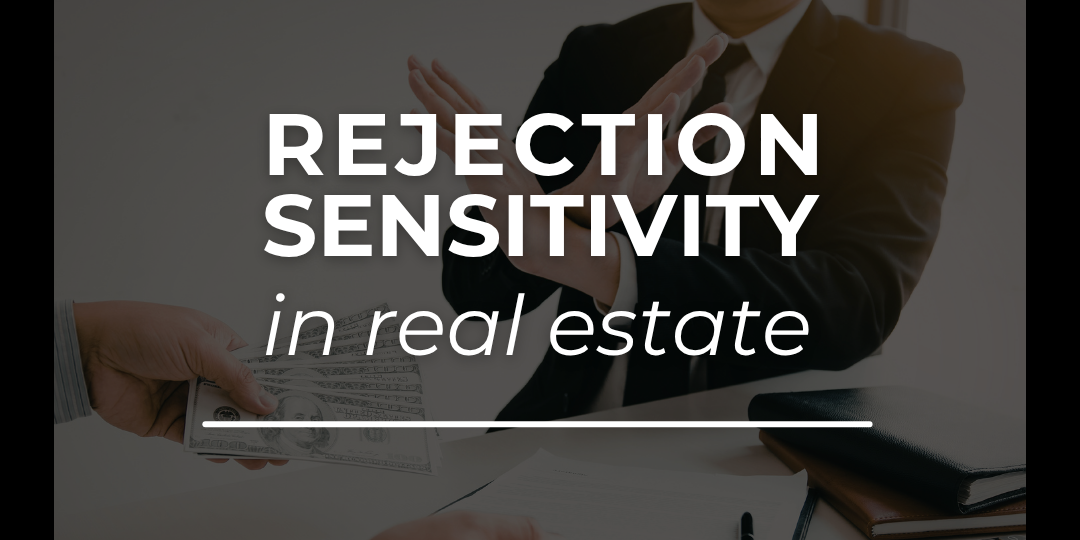
Rejection Sensitivity in Real Estate: Why a “Lost Listing” Feels Like a Broken Heart
You might know this feeling intimately. You spent hours preparing a thoughtful, strategic listing presentation. You pulled comps, customized your marketing plan, and walked into that appointment genuinely ready to serve. More than that, you connected with the homeowners—you could feel it.
Then the message comes through: “We’ve decided to go with another agent. Thanks for your time.”
For most people, that lands as a mild disappointment. A shrug, maybe a quick vent, and they move on. But when you’re wired with Rejection Sensitivity Dysphoria (RSD), it doesn’t feel like a professional outcome—it feels personal. Your stomach drops, your face flushes, and your brain wastes absolutely no time turning this into a full-blown identity crisis. Suddenly, you’re questioning your competence, your likability, and possibly your entire career choice… all before you’ve even finished reading the text. The urge to disappear (preferably under a weighted blanket with snacks and zero notifications) is very, very real.
What is RSD?
RSD is an intense emotional response to the perception of rejection, criticism, or even subtle social cues that might be interpreted as disapproval. It’s especially common in ADHD and Autistic brains, where the nervous system doesn’t quite know how to turn down the volume on emotional feedback. What might register as a “2” for someone else can feel like a “10” in your body.
In real estate, where rejection is baked into the business model, this creates a cycle that can quietly sabotage even the most talented professionals. A client chooses another agent, and your brain immediately fills in the blanks with a harsh narrative: You’re not cut out for this. You’re behind. Everyone else is doing better. That internal spiral doesn’t just feel bad—it drives behavior. To avoid experiencing that level of discomfort again, you start pulling back. Fewer calls. Less follow-up. More “I’ll do it tomorrow” energy that somehow never resolves itself.
The “Data vs. Drama” Filter
Scaling your business doesn’t require you to magically grow thicker skin (if only it were that simple). What it does require is a reliable way to process what just happened so your brain doesn’t run the entire show. This is where the Data vs. Drama filter comes in.
The Drama is the story your brain creates in real time: They didn’t like me. I was awkward. I said the wrong thing. I’m never going to make another sale again and should probably start a new career as a barista. It’s compelling, immediate, and almost always wildly inaccurate.
The Data, on the other hand, is far less emotional and much more useful. It sounds like: They chose an agent they already knew. My presentation was thorough. I showed up prepared. I am still a licensed professional with years of experience. One of these narratives shuts you down; the other gives you something solid to stand on.
The 24-Hour Rule
Here’s the part most “just push through it” advice completely misses: your recovery time might be longer than someone else’s, and that is not a flaw—it’s information. Instead of fighting it, build a container for it.
Give yourself a 24-hour grace period when a deal falls through. Feel the disappointment fully without trying to override it with forced positivity or hustle energy. Vent to someone who gets it, take a break, eat the comfort food, cancel the non-essential plans if you need to. You’re not being dramatic; you’re regulating your nervous system.
Then, when that 24-hour window closes, you pivot intentionally. Look only at the Data and ask yourself one simple question: Is there something here I can learn, or was this just not my client? From there, you move forward—ideally toward something already on your Dopamine Menu so you’re not trying to restart from zero.
Why This Actually Makes You Better
The same sensitivity that makes rejection feel sharp is also what makes you exceptional at what you do. You notice nuance. You read people well. You care—deeply—and your clients feel that. That level of empathy cannot be taught in a script or a training.
The goal isn’t to become less sensitive. The goal is to have a plan for when that sensitivity gets loud, so it doesn’t take you out of the game.
A “No” will always sting a little. That’s part of being human. But it doesn’t get to rewrite your story or shrink your business unless you let it. Your job isn’t to become a robot who shrugs everything off; it’s to stay in motion, even when the emotional volume spikes.
Reflection for the Week
Think about a recent “No.” When you look at it now, was it actually a statement about your worth—or was it just data your brain dressed up as something more?