I’ve spent years coaching people through seasons where they feel stuck, stalled, or somehow “behind.” And there’s a phrase I keep coming back to over and over again—one that tends to take a weight off people the moment they hear it:
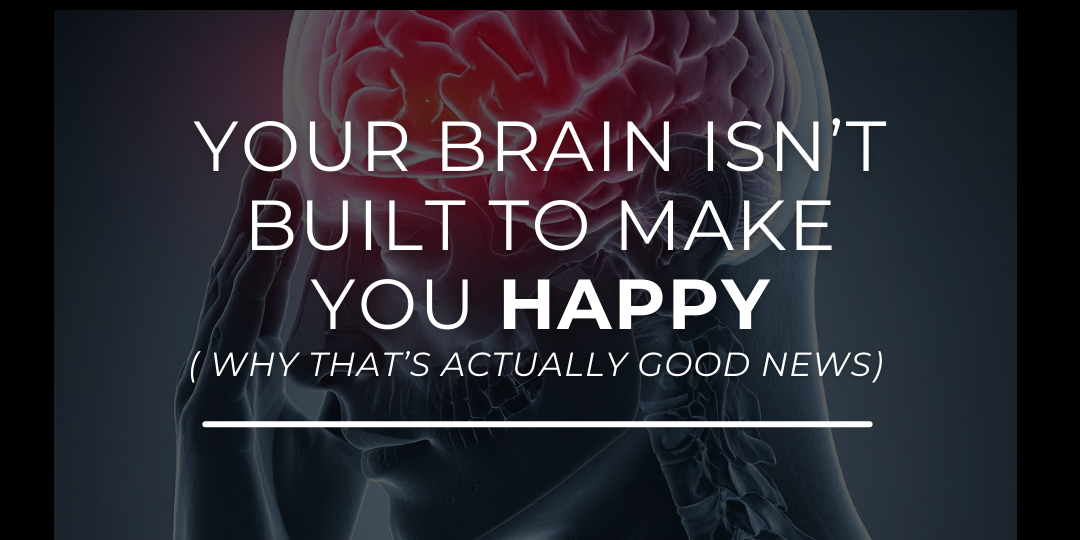
Your brain is not designed to make you happy. Your brain is designed to keep you safe.
Now, that doesn’t mean you can’t be happy, of course. But biologically, happiness is a bonus—not the factory setting. Understanding that one truth changes everything about how we show up, how we pursue goals, and how we interpret the feeling of resistance that shows up right when we’re trying to grow.
Let me take you into the science part of it for a moment.
The Safety System Running the Show
One of the brain’s core “safety features” is the Reticular Activating System (RAS)—a bundle of nerves at the base of your brainstem that acts like a filter. It decides what information gets your attention and what gets ignored.
This isn’t new research; the RAS has been studied for decades, but two findings are especially powerful for understanding why we get stuck:
1. The RAS amplifies anything it considers relevant to your survival.
A foundational study by Moruzzi & Magoun (1949) demonstrated that the RAS is directly responsible for regulating wakefulness and attention—meaning it prioritizes what you notice, what you pursue, and what you avoid.
Practically speaking?
If your brain associates change with danger, your RAS highlights every possible obstacle, risk, or reason to stay put.
2. The RAS strengthens whatever patterns you repeat.
Later research by Pribram & McGuinness (1975) explored how arousal systems like the RAS reinforce behavioral patterns, especially those tied to emotional significance—fear, uncertainty, embarrassment, rejection.
Translation: If you’ve spent years operating in a certain way—even if it makes you unhappy—your brain will try to keep you there because it’s known. Known equals safe in the primitive brain. Your brain would rather keep you unfulfilled but alive than expansive and uncomfortable. It sounds bleak, but it’s actually empowering once you understand the mechanism.
The Primitive Brain Still Thinks We’re Living in a Wilderness
Thousands of years ago, staying with the group, following routines, and avoiding risk were literal survival requirements. Confrontation, change, uncertainty, standing out, or trying something untested? Those things could get you exiled, injured, or eaten.
Even today, our brains treat the following things as if we’re about to wander away from the firelight into the dark woods alone:
- trying something new
- setting a big goal
- walking into a room full of strangers
- posting content online
- asking for help
- changing careers
- raising our standards
- leaving an unhealthy pattern
This is why social belonging, approval, and status triggers feel so intense. Primitive humans relied on group acceptance for survival. Researchers like Baumeister & Leary (1995) confirmed that belonging is a fundamental human need—so much so that social rejection activates the same neural pathways as physical pain.
Your hesitation is not a character flaw. It’s biology.
When Safety Becomes a Cage
Because the brain is wired for familiarity and protection, it interprets many forms of personal growth as danger:
- Want to speak publicly?
Your brain warns you that criticism = death. - Want to lose weight or change habits?
Your brain tells you that old routines = safe. - Want to start a business?
Your brain says uncertainty = risk. - Want to leave a relationship, a job, a friendship that has expired?
Your brain whispers, “But at least we know this.”
The RAS will filter your world so you see evidence supporting the path of least resistance—not because it’s right, but because it’s predictable; and predictability feels like safety.
This Isn’t About Willpower, Strength, or Ability
This is the part I never want people to miss:
- Your resistance to change is not a reflection of your character—it’s evidence of your wiring.
- You are not flawed because you hesitate.
- You are not weak because you doubt yourself.
- You are not broken because old patterns feel easier.
- You are not unmotivated because you avoid discomfort.
- You are a human with a brain designed for survival.
- The safety alarms going off in your mind are genetic instructions—not moral ones.
So How Do We Get Un-Stuck?
Getting “unstuck” isn’t about overpowering your brain. It’s about retraining it. Here’s where your RAS becomes your ally instead of your obstacle:
- Decide what you want with clarity. The RAS needs a target. Goals, affirmations, vision boards, journaling—they all feed the system new parameters.
- Repeat the new pattern often enough that “unfamiliar” becomes “safe.” Your brain won’t trust something new until it has seen it consistently.
- Expect discomfort—not as a sign you’re on the wrong path, but as proof you’re on the right one. Discomfort is the RAS trying to protect you. Thank it. Then continue.
- Surround yourself with other people who normalize growth. Your social wiring is powerful. Belonging to a growing group tells your brain, “This is safe too.”
You Are Not Fighting Yourself—You’re Updating Yourself
Every time you stretch, every time you aim higher, every time you challenge old beliefs, you’re not battling your brain. You’re simply asking it to evolve beyond its outdated survival script.
And it can.
It just needs leadership — your leadership.
Once you understand that safety, not happiness, is your brain’s default motive, you can stop taking your resistance personally. You can stop thinking something is wrong with you. You can start guiding your brain instead of being ruled by it.
And that’s when people get truly, deeply unstuck.
You’ve got this. I believe in you.
Coach Lins